Wheel
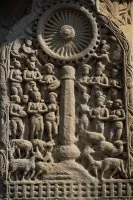
The wheel (cakka) is a flat circular object that turns as it moves. The ancient Indians used the wheel as a symbol for political sovereignty and dominion. The first Buddhists used it as a symbol for sovereignty too, but for spiritual rather than for political sovereignty. The Buddha’s first discourse is called ‘Setting in Motion the Wheel of the Dhamma’ (S.V,420 ff). The rim (mukhavaṭṭi) of the wheel represent movement or progress and the spokes (ara) and hub (nābhi) represent the coming together of multiple things into a unity. Generosity, kindly speech, doing good for others and treating them with impartiality are to the world, the Buddha said, what the linchpin (āṇi) is to the wheel (A.II,32), i.e. they keep it turning smoothly. A wheel flanked on either side by a deer has long been used to symbolize the Buddha’s teaching of this first discourse in the Deer Park at Sārnāth.
Today the wheel as a symbol for Buddhism is often depicted with eight spokes representing the Noble Eightfold Path although this is a relatively recent innovation. In the scriptures the Dhamma wheel, called either the Supreme Wheel (brahmacakka) or Highest Wheel (anuttaraṃ dhammacakkaṃ, A.III,9; 148), is described as being ‘a thousand-spoked’ (sahassāraṃ, D.III,60). Before the advent of statues, the Buddha was often represented by a wheel. What the cross is to Christians, the ying yang symbol to Taoists and the Om sign to Hindus, the wheel is to Buddhists. See Basis of Community.
Further reading: The Buddhist Wheel Symbol, T. Karunaratne, 1969.
Subjects: Culture and Traditions