Nuns
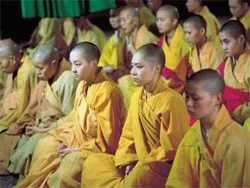
A nun (bhikkhuṇī) is a woman who has renounced ordinary society to live a celibate monastic life. The contemporary terms ‘female monk’ or ‘female priest’ are misnomers. Nuns are the second of the four members of the Buddhist community (parisā), the others being monks, lay men and lay women. To be properly ordained, a woman must be ordained first by a quorum of nuns and then a second time by a quorum of monks. Some nuns in the scriptures are described as being learned (bahussuta), eloquent (bhāṇika), confident (visārada) and outstanding at teaching the Dhamma (paṭṭha dhammaṃ kattaṃ katuṃ, Vin.IV,290). The Therīgāthā, one of the books in the Buddhist scriptures, contains poems composed by 73 individual nuns, and the Bhikkhunī Saṃyutta of the Saṃyutta Nikāya contains 10 suttas by or about nuns (S.I,128-135).
At the time of the Buddha nuns were usually addressed both by other nuns and by lay people as ‘noble lady’ (ayye). Monks would usually address them as ‘sister’ (bhaginī). In Theravāda lands, the nun’s lineage died out around 1000 CE and traditionalists do not believe that it can or should be revived because there are no nuns to ordain new nuns. However, the nuns’ lineage continues in most Mahāyāna countries, and in places like Taiwan, nuns are a dynamic and respected presence within the Buddhist community. See Household Life, Mahā Pajāpatī Gotamī and Saṅghamitta
Further reading: Women Under Primitive Buddhism, I. B. Horner, 1990.
Subjects: Monastic Life
Mentioned in
- Alms Gathering
- Ambapālī
- Blood Sports
- Calendar
- Caste
- Caves
- Celibacy
- Clothes
- Disabilities, Physical and Mental
- Dreams
- Flexibility
- Food
- Forgiveness
- Goose, the
- Household Life, the
- Incest
- Jīvaka Komārabhacca
- Mahā Pajāpatī Gotamī
- Monastery
- Money
- Monks
- Nudity
- Ordination
- Pātimokkha
- Penis
- Psychic Power
- Requisites, the Eight
- Rivers
- Robes
- Saṅgha