Devil, the
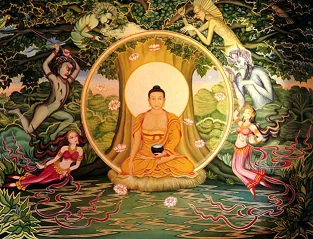
In theistic religions the Devil, sometimes also known as Satan, Lucifer or Beelzebub, is a being completely opposed to God and to goodness. According to the Tipiṭaka, the Buddha was approached on several occasions by a spirit named Māra who tried to stop him from continuing his struggles for enlightenment, to tempt him and to encourage him to pass away (Sn.426; D.II,104). Many Buddhists believe that Māra is an actual being while others contend that it is really an allegory or a personification of negative states of mind. There would seem to be more evidence for this second opinion than for the first. This is apparent from the fact that the Pāḷi word māra means ‘death’ or ‘bringing death’ and that Māra’s three offsprings are named Craving (Taṇhā), Discontent (Aratī) and Craving (Ragā, S.I,124). Further, the Buddha describes the army that Māra used to attack him with as being made up of sensual desire, dislike, hunger and thirst, craving, sloth and laziness, fear, restlessness, gains, honour and fame, undeserved reputation and exalting oneself and disparaging others (Sn.436-8).
This interpretation is further supported by the fact that Buddhism sees evil as thoughts, speech and action motivated by ignorance rather than the machinations of a force external to the human mind. Māra is sometimes also called the End-maker (Antaka, S.I,72), the Dark One (Kaṇha, M.I,377) or the Binder (Namuci, D.II,259).
Further reading: Buddhism and the Mythology of Evil, Trevor Ling, 1965.
Subjects: Culture and Traditions